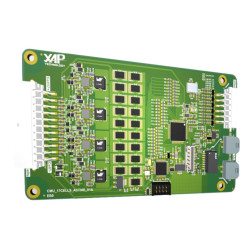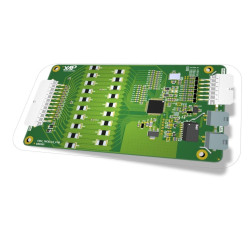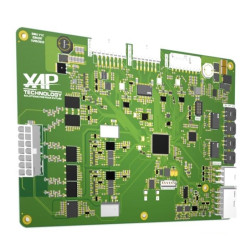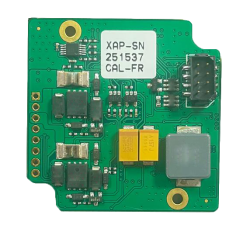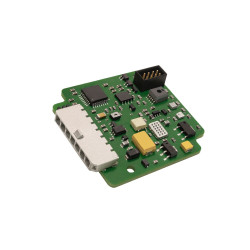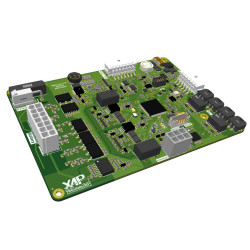
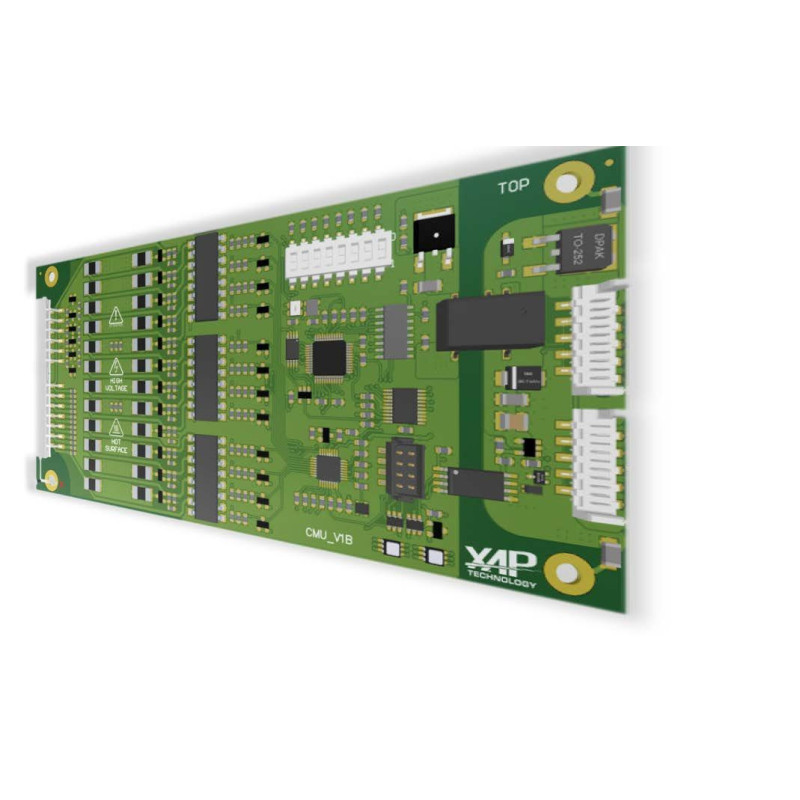

The XAP Technology CMU-112 is a cell monitoring and balancing unit designed for automotive and industrial battery architectures. It measures 12 cell voltages, monitors up to eight temperatures and sends data to the BMU over an isolated CAN bus. Its modular design enables integrators to build anything from a 48 V battery pack to a high-voltage architecture of up to 800 V without modifying the CMU hardware.
The CMU-112 combines filtered, oversampled measurement channels with a stated accuracy of ±1 mV. Its passive balancing system sequentially discharges the cells with the highest voltage, targeting a voltage difference below 25 mV between cells. The microcontroller coordinates measurement, fault detection, balancing and communication.
Each unit operates autonomously within the XAP BMS architecture. Automatic identification and dynamic addressing simplify wiring and in-field reconfiguration, while the integrated memory stores the information required for traceability, including the serial number, calibration parameters and firmware identifier.
The stated 3,000 V galvanic separation between the cell domain, logic and CAN bus supports controlled electrical integration. XAP complements this architecture with reverse-polarity protection, electrostatic discharge suppression, overvoltage clamping and open-wire detection.
The CMU-112 integrates into modular battery management systems for automotive and industrial environments, from 48 V battery packs to high-voltage architectures of up to 800 V.
The CMU-112 integrates as a cell monitoring unit within the XAP BMS architecture. It receives a 12 to 17 V DC supply from the BMU and communicates over an isolated CAN bus. EEPROM identification and dynamic addressing allow multiple units to be organised within a modular architecture.
The integrator connects the 12 voltage channels, up to 6 external NTC sensors, the BMU power supply and the CAN bus in accordance with the system documentation. The source does not provide a pinout or connector reference, so XAP must confirm the wiring, battery-pack protection, CAN termination and BMU compatibility before final installation.
| Specification | Value |
|---|---|
| Voltage measurement | 12 channels, 0 to 5 V each; stated accuracy of ±1 mV; summed pack voltage up to 48 V; 3 kV galvanic isolation |
| Temperature monitoring | 6 external NTC sensors and 2 internal sensors; measurement range from –20 °C to +70 °C; stated accuracy of ±1 °C; local overtemperature detection and alert flag |
| Balancing method | Passive resistive balancing, approximately 4.7 Ω / 3 W per cell; discharge controlled by optocoupled MOSFET drivers |
| Balancing algorithm | Sequential discharge of the cells with the highest voltage; target ΔV < 25 mV between cells |
| Supervision | Microcontroller managing measurement, fault detection, balancing and communication |
| Memory and traceability | 512 kB for the serial number, hardware configuration, calibration parameters, firmware identifier and local history |
| Power supply | 12 to 17 V DC from the BMU; protected input |
| Communication | 1 isolated CAN bus; XAP proprietary protocol; watchdog reset |
| Isolation | 3,000 V galvanic separation between the cell domain, logic and CAN |
| Protection | Reverse polarity, ESD suppression, overvoltage clamping and open-wire detection |
| Current consumption | 250 mA maximum |
| Diagnostics | Start-up self-test and watchdog timer |
| Specification | Value |
|---|---|
| Operating temperature range | –40 °C to +85 °C |
| Ingress protection | IP40, bare board |
| Vibration and shock | Automotive grade, IEC 60068-2-6 / -27 |
| Electromagnetic compatibility | Stated compliance with UNECE R10 / ISO 11452 |
| Safety standards | Stated compliance: ISO 26262 ASIL-B at CMU level / UNECE R100 / R136 |
| Reliability | More than 13,000 h of continuous operation stated |
| Specification | Value |
|---|---|
| Dimensions | 144 × 70 × 10 mm |
| Weight | Approximately 30 g |
| Reference | Description |
|---|---|
| To be confirmed with XAP | CMU-112 |
You might also like